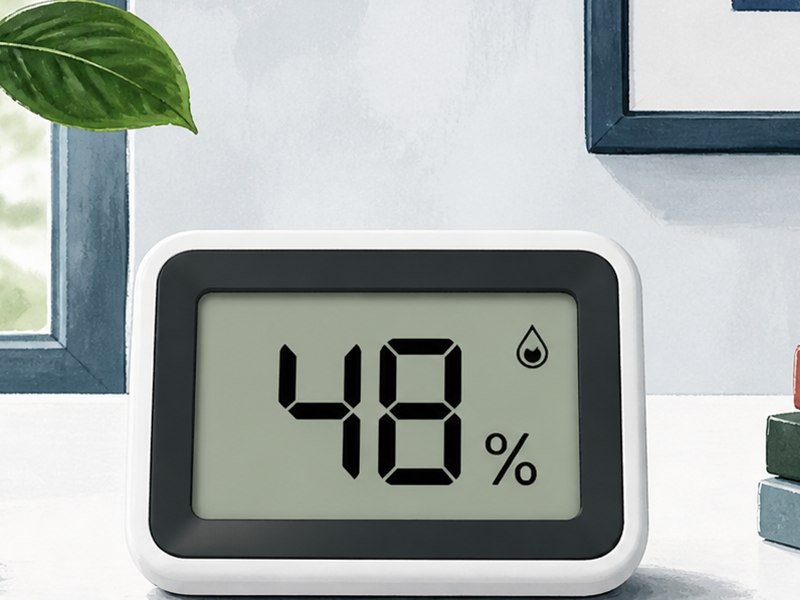
 Illustration
Quick manual check · no app
TempPro TP49
Model TP49
Move it between rooms and read the display yourself. It does not save a history.
View on Amazon (affiliate link, opens in a new tab)INDOOR HUMIDITY · DECISION WORKSPACE
Check a reading, find the cause, or compare equipment. Start with the closest match; you do not need to read everything.
01 · CHECK A READING
Use a representative room location and check again under comparable conditions.
Temperature, recent showers or cooking, open doors, weather, sensor placement, HVAC runtime, and room-to-room differences can all change what one number means.
A reading can show a pattern worth checking. It cannot diagnose mold, a hidden leak, an HVAC defect, or moisture inside materials.
NEED A HUMIDITY MONITOR?
Use the TP49 for a quick manual check with no app. Use the Govee H5075 when you want one room to record a continuous history you can review over Bluetooth. Neither finds the moisture source.
IllustrationQuick manual check · no app
Model TP49
Move it between rooms and read the display yourself. It does not save a history.
View on Amazon (affiliate link, opens in a new tab)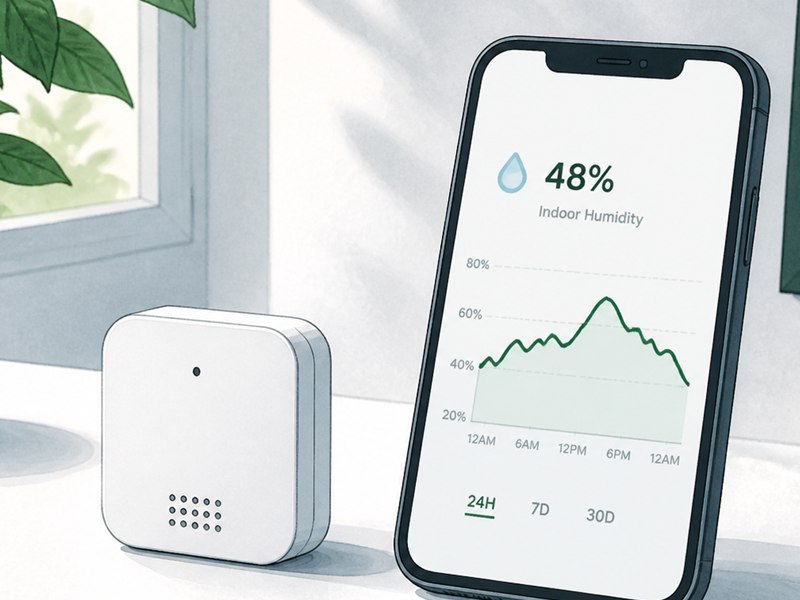 Illustration
Continuous history · Bluetooth app
Model H5075
Leave it in one room to record changes over time, then review the history in the Bluetooth app.
See the current Amazon listing (affiliate link, opens in a new tab)02 · FIND THE CAUSE
The diagnostic routes you toward measurement, source investigation, HVAC review, or a bounded equipment decision. It does not diagnose a building or health condition.
DIAGNOSE MY HUMIDITY PROBLEM
Answer a few questions. The tool routes you toward the next investigation step; it does not diagnose mold, HVAC defects, hidden leaks, structural failures, or health conditions.
Stop ordinary troubleshooting first if there is active water, contaminated water, electrical risk, unsafe access, extensive wet material, or structural concern.
Question 1 of up to 5 · First fork
Examples include damp material, staining, swelling, peeling finishes, musty odor, condensation collecting on surfaces, or known water intrusion.
Verify. Compare an independent humidity-and-temperature reading in a representative location.
Map. Note rooms, floors, times, weather, activities, and recent changes.
Separate. Distinguish humid air from wet materials, staining, odor, condensation, or water entry.
Decide. Choose observation, monitoring, source correction, equipment, or qualified help.
03 · CHOOSE EQUIPMENT
Start with the ownership burden you can accept, then compare the products that fit. We separate documented facts, owner-report signals, and what we still do not know.
Measure again or investigate the source first.
Use the diagnostic ↑Compare rooms and decide whether the problem is local or building-wide.
Check likely causes ↑Choose equipment type, capacity, drainage, and ownership burden.
Compare 10 products ↓FIRST, COMPARE THE RIGHT JOB
Only after elevated humidity repeats and active water or wet materials are being addressed.
Use a portable for one defined area. Crawl-space and whole-house equipment need a verified wider problem and installation planning.
Start with moisture severity and operating temperature, then compare standardized pint capacity—not square-foot claims alone.
Choose around the route you can actually maintain: empty a bucket, drain downhill, or pump upward.
Use AC when cooling is the main job. Consider added drying only when moisture remains after normal cooling and source checks.
10 PRODUCTS · ONE HONEST VIEW
“Support not verified” means exactly that—we found product information but do not have strong evidence that getting help is easy.
A room or basement where a normal bucket or downhill hose is enough.
Conventional shape and no pump keep the setup simpler. It still adds heat and needs filter and bucket access.
Confirm the exact non-pump model and test drainage and shutoff during the seller’s return window. Support responsiveness is not independently verified.
Someone who values fewer emptying trips and smart controls but does not need a pump.
The large reservoir reduces trips but is heavier when full. Existing research found recurring owner complaints about icing, sensors, and durability.
Treat it as a convenience-first choice. Confirm the non-pump model and buy where a heavy appliance is realistically returnable.
A familiar upright format and easier bucket handling matter more than the Cube design.
Current owner-review research commonly describes effective drying and a tolerable fan-noise profile; this is not hands-on testing.
Neighboring Frigidaire models look similar. Confirm FHDD5034W1, warranty terms, seller returns, and local service access.
Water must move upward to a sink, window, or standpipe.
The pump solves lift, but mixed owner reports mention pump failure, sensor problems, and support friction.
Test the pump route immediately. Do not accept a non-pump variant or pay for the pump when gravity drainage works.
An encapsulated crawl space with service clearance and a reliable downhill drain.
Low-profile dedicated equipment avoids bucket duty. Filter access, clearance, and continuous drainage become the ownership work.
Compare standardized AHAM capacity—not the larger saturation claim. Confirm warranty, return freight, filter supply, and current stock.
A smaller crawl space where condensate genuinely must be pumped.
The compact body helps access; the pump adds a failure and maintenance point. App behavior and support have not been independently verified.
Do not undersize because it costs less. Confirm pump lift, capacity, service clearance, return freight, and warranty process.
A large or difficult encapsulated crawl space that needs higher capacity, ducting, and pumped drainage.
Heavy, ductable equipment needs planned access, sound tolerance, drainage, and service space.
Manufacturer stock was unresolved at the last check. Do not use this to mask standing water, leaks, or missing encapsulation.
Restoration-adjacent or unusually wet spaces after the water source is controlled.
Commercial-style drainage and output bring more heat, sound, weight, power, and service burden than a room portable.
Its 160-pint headline uses saturated conditions and is not directly comparable with a consumer 50-pint DOE rating.
Building-wide humidity where an integrated system makes more sense than several portables.
The installer relationship matters as much as the box: ducting, drainage, controls, commissioning, filters, and future service all stay with the home.
The previously reviewed Amazon bundle was unavailable. Confirm installer compatibility, warranty eligibility, service access, and bundle contents before ordering.
Tight installed or ducted applications, crawl spaces, or smaller-home integration.
Compact placement can help, but this is still installed equipment with drainage, filtration, controls, and service-access needs.
Confirm the installer will support the exact unit, the filter remains obtainable, and removal for service is practical.
CURRENT AFFILIATE PURCHASE LINKS
This is not the whole comparison. These are the exact listings with a currently approved affiliate destination, shown with clearly labeled product-class artwork. Confirm the model, seller, return terms, price, and availability before buying.
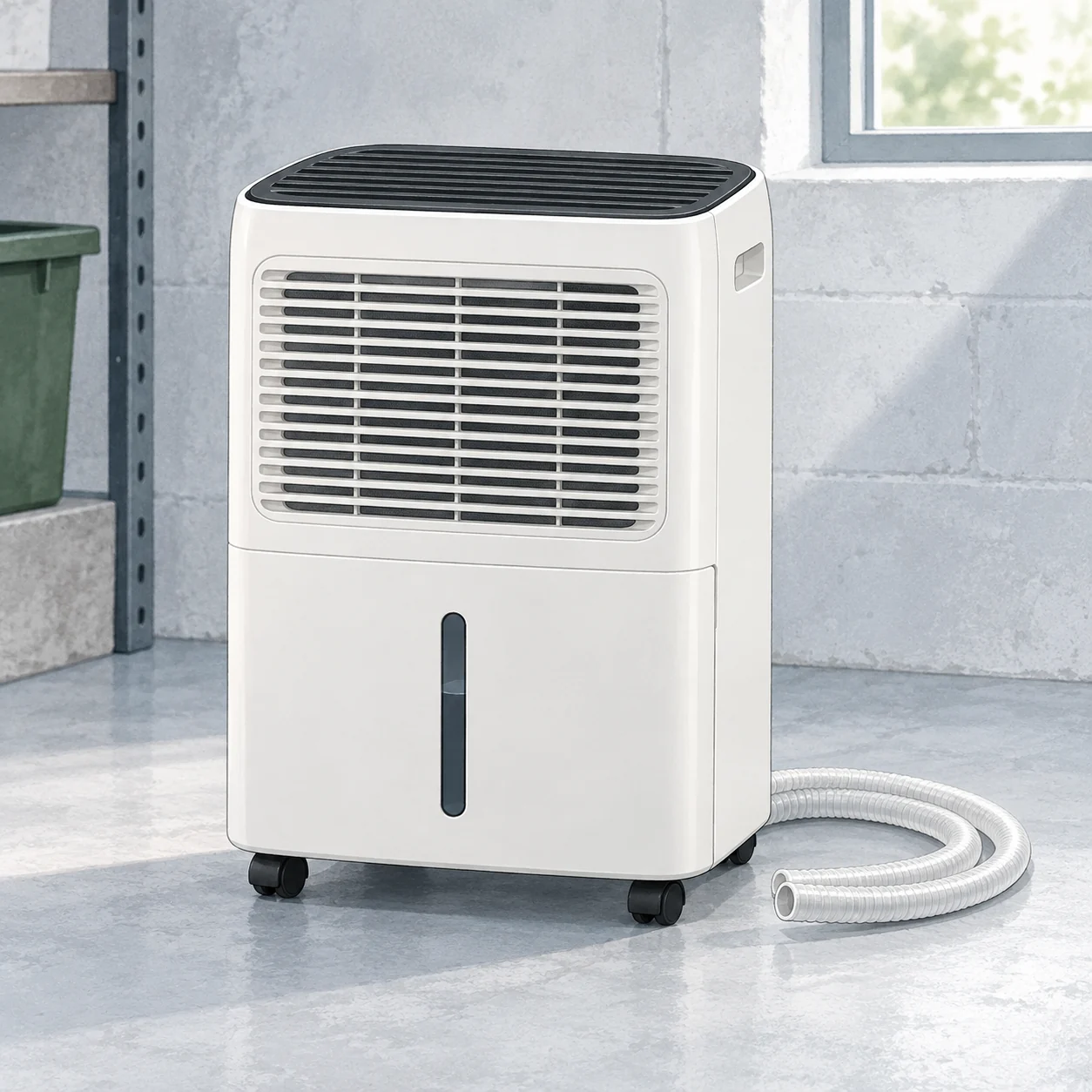
Basic bucket or gravity-drain portable
Model MAD35C1AWS
Basic bucket use or downhill gravity drainage when a pump is unnecessary.
Check current price on Amazon (affiliate link, opens in a new tab)Large-bucket or gravity-drain portable
Model MAD50S1QWT
Bucket use or downhill gravity drainage when pumped drainage is not needed.
Check current price on Amazon (affiliate link, opens in a new tab)Portable with built-in pump
Model MAD50PS1QWT
Pumped drainage when the drain destination is above the dehumidifier.
Check current price on Amazon (affiliate link, opens in a new tab)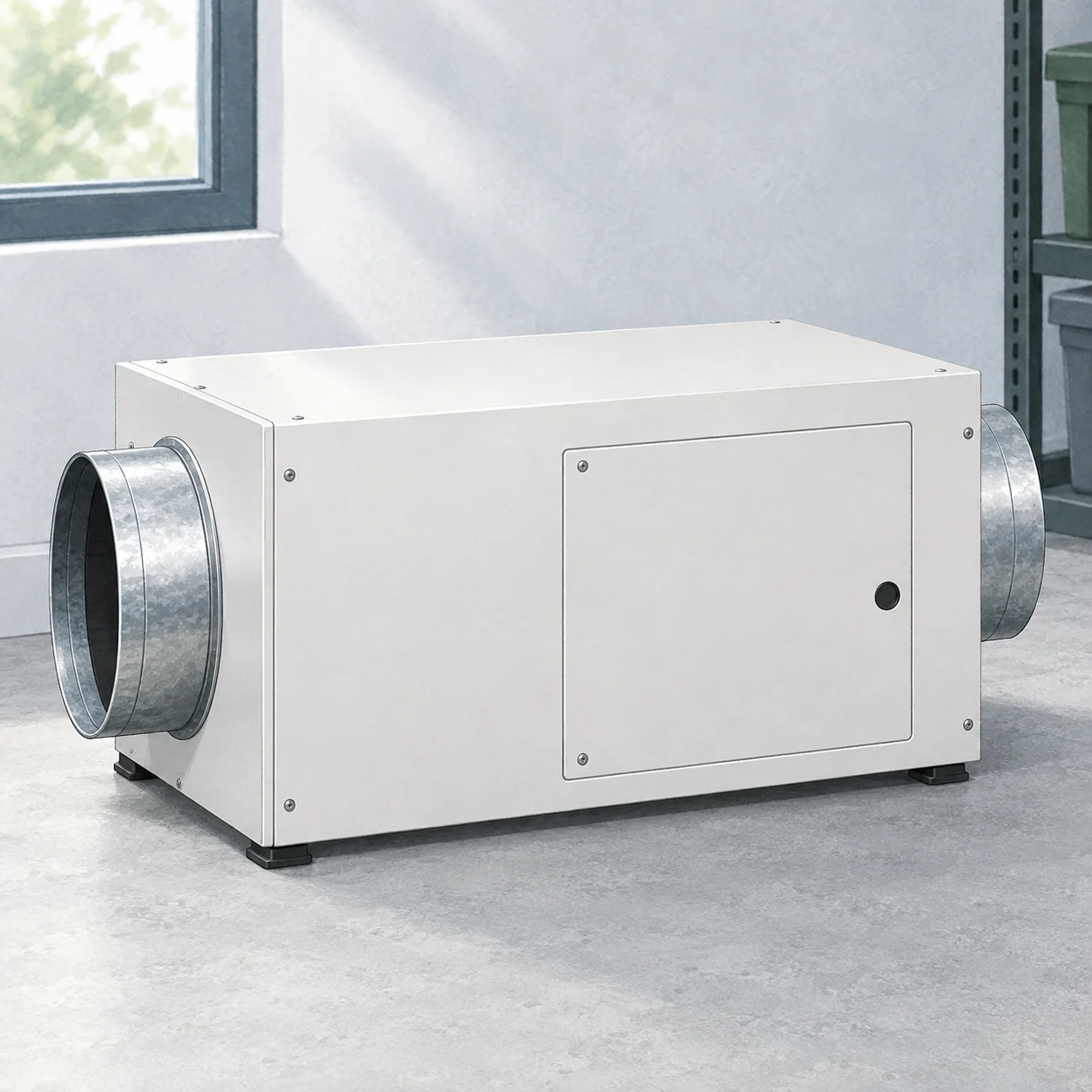
Installed whole-house dehumidification
Model E080
Whole-house or installed-equipment evaluation when portable dehumidifiers no longer match the scope.