Will it run?
Add the loads that must run together and compare that number with rated continuous output.
BACKUP POWER · BUYING GUIDE
Choose what must keep running, how long it matters, and whether a battery, generator, or professional plan fits the job.
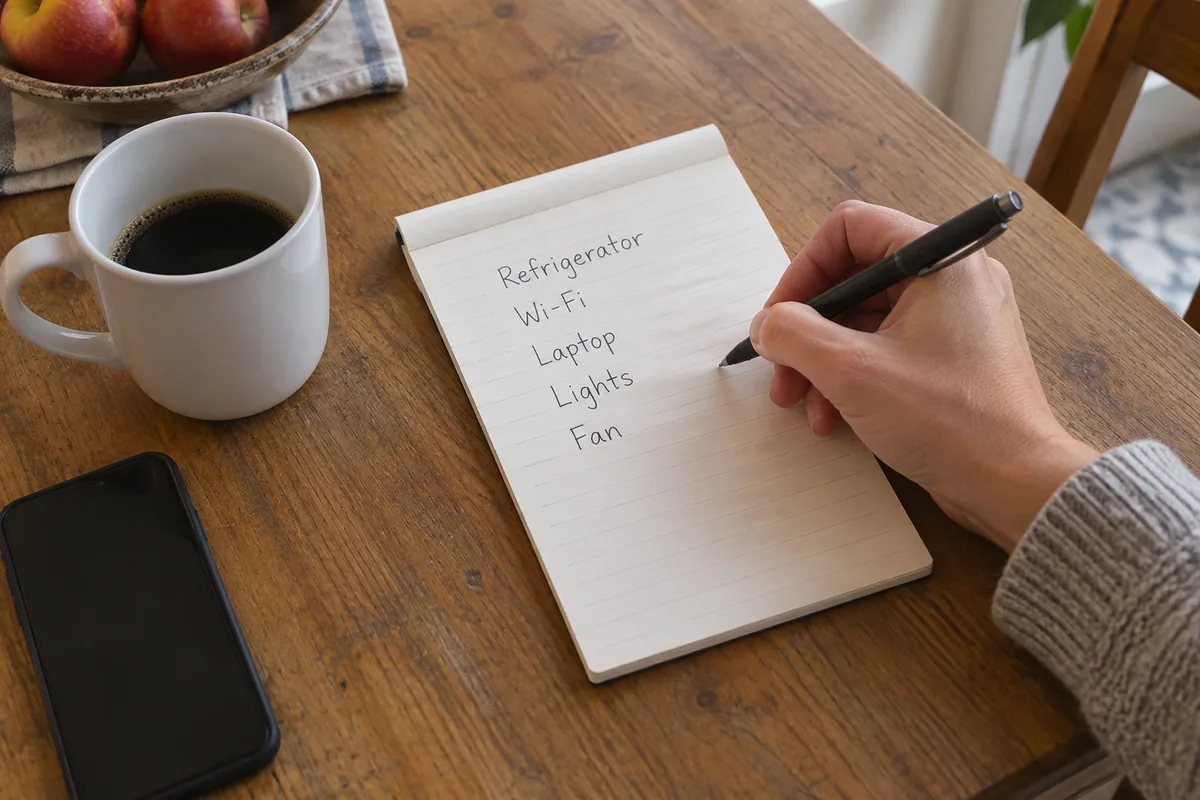
Choose everything that matters. You do not need to know watts or volts.
03 · CHOOSE EQUIPMENT
Start with the load and ownership burden you can accept. Then compare products that fit—not the largest number on the box.
Define the job or get appropriate help first.
Use the homeowner guide ↑Measure demand and decide what must run together.
Change your answers ↑Compare the product class and ownership reality.
Compare 8 products ↓FIRST, COMPARE THE RIGHT JOB
Add the loads that must run together and compare that number with rated continuous output.
Refrigerators, pumps, and motors may briefly need much more power than their running watts.
Battery watt-hours are a finite runtime budget. Fuel helps only when storage and refilling are safe.
Batteries can operate indoors. Combustion generators require genuinely safe outdoor placement.
Grid, vehicle, solar, or fuel access can change the plan; none should be assumed during an outage.
8 CURRENT PRODUCTS · ONE HONEST VIEW
Specifications are manufacturer-published, not hands-on test results. Runtime depends on the actual load, conditions, and setup.
Phones, Wi-Fi, lights, and a laptop where portability matters more than long runtime.
Compact enough to move and store easily. Quiet indoor operation avoids fuel and exhaust work.
Not a refrigerator-first or long-outage system. Add the actual simultaneous load before buying.
A refrigerator, communications, fans, and measured plug-in essentials used in shifts.
Higher output in an indoor-safe package, but one kilowatt-hour is still a bounded energy reserve.
Verify refrigerator startup demand and calculate hours from measured use—not appliance labels alone.
Several plug-in essentials where fast transfer and multiple charging options are useful.
Portable in category, but heavy enough that storage and carrying distance deserve a plan.
Confirm outlet layout, recharge assumptions, noise under load, and whether 1kWh is enough for the desired hours.
More indoor runtime for refrigeration and essentials without storing or burning fuel.
Twice the stored energy of the 1kWh class, with substantially more weight and a longer recharge job.
Still finite. High-load heating, cooking, cooling, or pumps can consume the reserve quickly.
Refillable power when the property has a safe outdoor operating location and fuel plan.
Runtime can be extended with fuel, but every use brings exhaust, noise, weather, maintenance, and cord-routing work.
Never run indoors, in a garage, shed, porch, or near openings. It is not an apartment or balcony option.
A lighter 1kWh alternative for refrigeration and ordinary plug-in essentials.
High solar input and low listed weight make it unusually portable in this class.
Compare port layout, app dependence, service access, and the current seller-specific warranty before buying.
High-output plug-in loads, especially when DJI drone charging or high-power USB-C matters.
Strong output and quiet operation, with some charging advantages tied to DJI-specific accessories.
Compare AC outlet count, accessory costs, and whether DJI-specific charging adds value for your household.
A middle step between 1kWh portability and a 2kWh outage reserve, with weather resistance.
The rugged enclosure and 1.5kWh capacity trade compactness for more reserve and outdoor durability.
Compare weight, price per watt-hour, solar input, and the value of weather resistance against 2kWh competitors.
Fully Considered has not personally tested the named products. Recommendations are based on documented specifications, safety guidance, and decision fit. This workspace cannot inspect wiring, measure a load, establish generator placement, or replace medical, electrical, or emergency guidance.